AI-clustering identificeert functionele risicofenotypen bij hartfalen
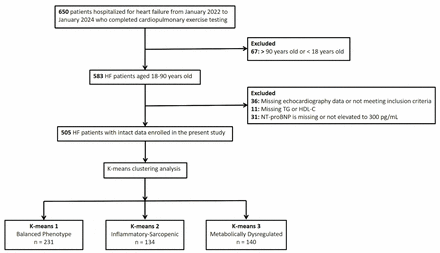
Bij 505 hartfalenpatiënten werd met unsupervised AI-clustering op basis van 15 multimodale klinische variabelen — waaronder metabole, inflammatoire en lichaamscompositieparameters — onderscheid gemaakt tussen functionele risicofenotypen.
De clusters voorspelden cardiorespiratoire fitheid en klinische uitkomsten, wat kan helpen bij vroege risicostratificatie.
Abstract (original)
BACKGROUND: Patients with heart failure (HF) frequently suffer from undetected declines in cardiorespiratory fitness (CRF), which significantly increases their risk of poor outcomes. However, current clinical practice lacks effective tools for early CRF risk stratification. METHODS: We conducted an artificial intelligence (AI)-driven unsupervised clustering analysis based on 15 multimodal clinical variables-including metabolic, inflammatory and body composition indicators-in 505 patients with HF. The associations between clustering-derived phenotypes and CRF impairment (maximal oxygen uptake (VO2 max) ≤20 mL/kg/min) were evaluated using multivariable logistic regression and five supervised machine learning models. SHapley Additive exPlanations analysis was applied for model interpretability. External validation was performed in an independent cohort of 201 patients. RESULTS: Three distinct phenotypes were identified: balanced, inflammatory-sarcopenic and metabolically dysregulated. Compared with the balanced phenotype, both non-balanced phenotypes showed significantly higher odds of impaired VO₂ max. In the derivation cohort test set, random forest (area under the curve (AUC)=0.75; 95% CI 0.62 to 0.87) and XGBoost (AUC=0.74; 95% CI 0.62 to 0.87) demonstrated the best discriminative performance. In the external validation cohort, the highest discrimination was observed for Naive Bayes (AUC=0.75; 95% CI 0.67 to 0.83), followed by random forest (AUC=0.74; 95% CI 0.58 to 0.91). CONCLUSION: By integrating multimodal clinical data with AI-driven clustering and machine learning, this study identified novel CRF risk phenotypes in patients with HF and established a highly interpretable and generalisable risk stratification model. These findings offer a valuable framework for early functional assessment and pave the way for precision rehabilitation strategies in HF management.
Dit artikel is een samenvatting van een publicatie in Open heart. Voor het volledige artikel, alle details en referenties verwijzen wij u naar de oorspronkelijke bron.
Lees het volledige artikelDOI: 10.1136/openhrt-2025-003530
