A hepatocellular model to investigate the mechanisms in intracellular trafficking of APOB–VLDL
- Pediatrics, University Medical Center Groningen, Groningen, Netherlands
- Pediatrics, University Medical Centre Groningen, Groningen, Netherlands
- University Medical Center Groningen, University of Groningen, Groningen, Netherlands
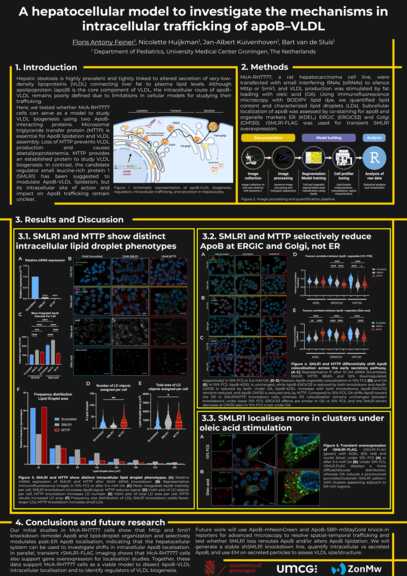
Hepatocellulair model om de intracellulaire route van apoB–VLDL te ontrafelen (UMC Groningen).
Bekijk de volledige poster op EAS 2026Poster on board · EAS 2026, Athene
Samenvatting
Achtergrond
Apolipoproteïne B (APOB) is het kerneiwit van VLDL, dat door de lever wordt geproduceerd en in de circulatie wordt uitgescheiden. Veranderingen in de intracellulaire APOB/VLDL-route hangen samen met metabool-disfunctie-geassocieerde steatotische leverziekte (MASLD) en ASCVD. De onderzoekers bestudeerden de VLDL-route met focus op SMLR1, een eiwit met onbekende functie dat samen tot expressie komt met MTTP, een sleutelfactor in het APOB-metabolisme.
Methoden
Er werd gebruikgemaakt van McA-RH7777-cellen (een rattenhepatoomcellijn die VLDL-achtige deeltjes uitscheidt). De cellen werden met siRNA's behandeld om Mttp of Smlr1 uit te schakelen; VLDL-productie werd gestimuleerd met oliezuur. Met immunofluorescentiemicroscopie (BODIPY-lipidekleuring) werden het lipidengehalte en de lipidedruppel-fenotypes gekwantificeerd, en de subcellulaire lokalisatie van APOB werd bepaald met organelmarkers.
Resultaten
Uitschakeling van Mttp (95%) gaf een ongeveer tweevoudige afname van het APOB-signaal en meer (vooral kleine) lipidedruppels; Smlr1-knockdown verhóógde juist het APOB-signaal en gaf minder maar grotere druppels. Mttp-downregulatie verhoogde de colokalisatie van APOB met lipidedruppels, terwijl Smlr1-knockdown die verlaagde. De lokalisatie van APOB naar het ERGIC en de Golgi was verminderd.
Conclusie
Mttp en Smlr1 beïnvloeden de intracellulaire APOB- en lipidedruppel-fenotypes verschillend, met vergelijkbare effecten op het APOB-transport voorbij het endoplasmatisch reticulum. Het model is geschikt om de intracellulaire route van APOB–VLDL verder te bestuderen.
Originele Engelstalige samenvatting (zoals ingediend bij EAS 2026)
Background and Aims
Apolipoprotein B (APOB) is the core protein of very-low-density lipoproteins (VLDL) which are produced by the liver and secreted into the circulation. Changes in the intracellular APOB/VLDL pathway are associated with metabolic associated steatotic liver disease (MASLD) and atherosclerotic cardiovascular disease (ASCVD), two major health concerns. Here we studied the VLDL pathway with a focus on small leucin-rich protein 1 (SMLR1), a protein of unknown function, that was identified through its co-expression with microsomal triglyceride transfer protein (MTTP) a key factor in APOB metabolism (https://doi.org/10.1002/hep.32709).
Methods
We used McA-RH7777 cells, a rat hepatocarcinoma cell line that is known to secrete VLDL- sized particles. The cells were transfected with small interfering RNAs (siRNAs) to silence Mttp or Smlr1. VLDL production was stimulated through incubation with oleic acid. Using immunofluorescence microscopy with BODIPY lipid dye, we quantified lipid content and characterized the lipid droplet (LD) phenotypes. Subcellular localization of APOB was assessed by co- staining for APOB and organelle markers.
Results
Silencing of Mttp (95%) resulted in an approximately two-fold reduction in APOB signal (A and B) and increased LD number and total area (C), with mostly small LDs. In contrast, Smlr1 knockdown (95%) increased APOB signal (A and B) and produced fewer but larger LDs. Furthermore, downregulation of Mttp increased the colocalization of APOB with LDs, whereas Smlr1 knockdown decreased their colocalization (D). In unstimulated cells, the colocalization between APOB and the endoplasmic reticulum (KDEL) remained unchanged after silencing Mttp or Smlr1, while the localisation of APOB to the ER-Golgi intermediate compartment (ERGIC53) and the Golgi (GM130) was reduced (E).
Conclusions
Our studies in McA-RH7777 cells indicate that Mttp and Smlr1 differentially affect the intracellular APOB and lipid-droplet phenotypes with similar effects on APOB trafficking beyond the ER. The data support the use of this hepatocellular model to investigate the intracellular route of APOB–VLDL.