Biomarker discovery study identifies 381 plasma proteins associated with risk of secondary major adverse cardiovascular events within three years after carotid endarterectomy
- Central Diagnostic Laboratory, University Medical Center Utrecht, Utrecht, Netherlands
- Julius Center, University Medical Center Utrecht, Utrecht, Netherlands
- Centre Of Population Health And Genomics, University of Virginia, Charlottesville, United States of America
- Central Diagnostics Laboratory, University Medical Center Utrecht, University Utrecht, Utrecht, Netherlands
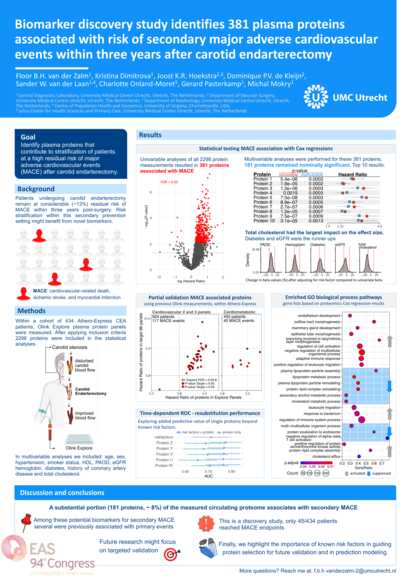
Biomarker-discovery: 381 plasma-eiwitten geassocieerd met nieuwe events na carotisendarteriëctomie (UMC Utrecht, Athero-Express).
Bekijk de volledige poster op EAS 2026Poster on board · EAS 2026, Athene
Samenvatting
Achtergrond
Patiënten die een carotisendarteriëctomie (CEA) ondergaan houden een aanzienlijk restrisico (~13%) op majeure cardiovasculaire events (MACE) binnen drie jaar na de operatie. Bestaande chirurgische modellen richten zich vooral op kortetermijnrisico. Om de risicostratificatie in deze secundaire preventie te verbeteren, zocht deze studie naar circulerende eiwitten die samenhangen met het MACE-risico.
Methoden
Plasma-eiwitten werden bij 434 patiënten uit het Athero-Express-cohort gemeten (Olink Explore 3072; 2298 eiwitten geanalyseerd). 45 patiënten kregen binnen drie jaar na CEA een MACE (myocardinfarct, beroerte of cardiovasculaire sterfte). Met uni- en multivariabele Cox-regressie, gene-set-enrichment en tijdsafhankelijke ROC- en ensemblemodellen werden geassocieerde eiwitten geïdentificeerd.
Resultaten
381 eiwitten waren univariabel geassocieerd met MACE (FDR<0,05), waarvan 181 multivariabel significant bleven. 44 verrijkte routes werden gevonden, waaronder endotheelontwikkeling, lipoproteïnemetabolisme en leukocytenmigratie. Het beste ensemblemodel (AUC 0,75) presteerde beter dan het model met alleen risicofactoren (AUC 0,62). Totaalcholesterol had de grootste invloed op de eiwit-effectgroottes.
Conclusie
De studie identificeert nieuwe kandidaat-biomarkers voor het MACE-risico in een secundaire-preventiesetting en benadrukt het belang van routinematig gemeten klinische risicofactoren bij de selectie van eiwitten voor toekomstige validatie en risicomodellen.
Originele Engelstalige samenvatting (zoals ingediend bij EAS 2026)
Background and Aims
Patients undergoing carotid endarterectomy (CEA) remain at considerable (~13%) residual risk of major adverse cardiovascular events (MACE) within three years post-surgery. Existing surgical models primarily focus on short-term MACE risk, while clinical predictors indicate substantial variation in long-term risk across patient groups. To improve risk stratification in this secondary prevention setting, this study aims to discover circulating proteins associated with MACE risk in CEA patients.
Methods
Plasma protein levels were measured in 434 patients from the Athero-Express cohort using Olink Explore 3072. After applying exclusion criteria and preprocessing, 2298 proteins were analyzed. Forty-five patients experienced MACE, defined as myocardial infarction, stroke, or cardiovascular death within three years after CEA. Univariable and multivariable Cox regression models were used to identify proteins associated with MACE. Gene set enrichment analysis was performed. The added predictive value over clinical risk factors was investigated using time-dependent ROC and ensemble- based models. To further explore the impact of accounting for known risk factors, we examined changes in proteins’ MACE effect sizes after adjusting for each factor individually.
Results
Univariable analysis identified 381 proteins associated with MACE (FDR < 0.05), of which 181 remained significant (p-value < 0.05) in multivariable models. Forty-four enriched pathways were identified, including those involved in endothelium development, lipoprotein metabolism, and leukocyte migration. The best ensemble model performance (AUC=0.753, 95% CI: 0.659-0.848) was obtained with univariately-significant proteomic data, improving on the best risk-factor-only model (AUC=0.622, 95% CI: 0.542-0.703). Total cholesterol had the greatest impact on protein effect sizes, other impactful factors were: eGFR, Diabetes, HDL and Hemoglobin.
Conclusions
This study identifies novel candidate biomarkers associated with MACE risk in a secondary prevention setting and highlights the importance of routinely measured clinical risk factors in guiding protein selection for future validation and risk stratification models.