Declining kidney function is associated with a KLF4-linked smooth muscle ECM program in human carotid atherosclerosis
- Central Diagnostics Laboratory, University Medical Center Utrecht, University Utrecht, Utrecht, Netherlands
- Laboratory Of Experimental Cardiology, Department Of Cardiology, University Medical Center Utrecht, University Utrecht, Utrecht, Netherlands
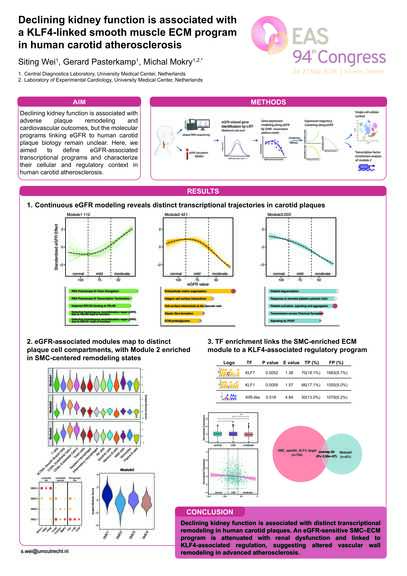
Afnemende nierfunctie hangt samen met een KLF4-gestuurd gladde-spiercelprogramma in humane carotisplaque (UMC Utrecht).
Bekijk de volledige poster op EAS 2026Poster on board · EAS 2026, Athene
Samenvatting
Achtergrond
Nierfunctiestoornis hangt sterk samen met gevorderde atherosclerose en een ongunstige cardiovasculaire prognose. Een dalend geschat glomerulair filtratietempo (eGFR) is gekoppeld aan veranderingen in arteriële structuur en plaquekenmerken, maar het intraplaque-transcriptieprogramma dat met de nierfunctie meebeweegt was onduidelijk.
Methoden
Carotisendarteriëctomie-plaques van 1087 patiënten ondergingen bulk-RNA-sequencing met bijbehorend eGFR. eGFR-geassocieerde genen werden geïdentificeerd en geclusterd in expressietrajecten (“modules”) met routeverrijking. De module-expressie per celtype werd onderzocht in single-cell-RNA-data van 46 humane carotisplaques. Transcriptiefactor-analyse en RNA-seq na KLF4-knockdown in myofibroblast-achtige cellen dienden ter validatie.
Resultaten
Drie eGFR-geassocieerde trajecten werden gevonden. Eén module (428 genen) was sterk verrijkt voor extracellulaire-matrix-organisatie en nam progressief af bij dalend eGFR. In single-cell-data was deze module het hoogst in gladde spiercellen (SMC's), specifiek in synthetische SMC-subclusters. Transcriptiefactor-analyse toonde een prominente KLF4-verrijking; de module correleerde positief met KLF4 en overlapte met gepubliceerde KLF4- en EndMT-signaturen.
Conclusie
De onderzoekers identificeren een KLF4-geassocieerd SMC-ECM-transcriptieprogramma waarvan de activiteit afneemt bij verslechterende nierfunctie en dat een nierfunctie-gevoelige SMC-toestand markeert in humane carotisplaques — een transcriptomische schakel tussen nierdisfunctie, SMC-fenotype en plaquebiologie.
Originele Engelstalige samenvatting (zoals ingediend bij EAS 2026)
Background and Aims
Renal dysfunction is tightly associated with advanced atherosclerosis and adverse cardiovascular outcome. Declining estimated glomerular filtration rate (eGFR) has been linked to characteristic changes in arterial structure and plaque characteristics, but the intraplaque transcriptional program that track kidney function in human carotid lesions remain unclear.
Methods
Carotid endarterectomy plaques from 1087 patients underwent bulk RNA sequencing with matched eGFR. eGFR-associated genes were identified using likelihood ratio tests, and their relationships with eGFR were modelled using generalized additive models (GAM). Significantly associated genes were clustered into expression trajectories (“modules”) followed by pathway enrichment. Module expression across cell types was examined in a single-cell RNA-seq dataset of 46 human carotid plaques. Transcription factor (TF) enrichment was performed to identify upstream regulators, and RNA-seq after KLF4 knockdown in human myofibroblast-like cells was used for validation.
Results
GAM-based clustering identified three distinct eGFR-associated trajectories. One trajectory (Module 3; 428 genes) was strongly enriched for extracellular matrix (ECM) organization and showed a progressive decrease in expression with declining eGFR. In single-cell data, Module 3 scores were highest in smooth muscle cells (SMCs) and selectively enriched in synthetic SMC subclusters, indicating an eGFR-sensitive SMC state. TF analysis revealed prominent KLF4 enrichment. Module 3 expression correlated positively with KLF4 (p<0.001), and Module 3 genes significantly overlapped published KLF4 Chip-seq and EndMT signatures. Differentially expressed genes after KLF4 knockdown overlapped Module 3.
Conclusions
We identify a KLF4-associated SMC-ECM transcriptional program whose activity declines with worsening kidney function and marks a kidney function-sensitive SMC state in human carotid plaques, providing a transcriptomic link between renal dysfunction, SMC phenotype and plaque biology.