Early treatment, lifelong impact: long-term cardiovascular outcomes of children with familial hypercholesterolemia
- Department Of Epidemiology And Data Science, Amsterdam UMC, location AMC, Amsterdam, Netherlands
- Department Of Pediatrics, Amsterdam UMC, location AMC, Amsterdam, Netherlands
- Department Of Internal Medicine, Frisius Medical Center, Leeuwarden, Netherlands
Volgt kinderen met FH tot in de volwassenheid om de cardiovasculaire winst van vroeg starten te kwantificeren — de Nederlandse cohortlijn rond Wiegman.
Bekijk de volledige poster op EAS 2026Poster on board · EAS 2026, Athene
Samenvatting
Achtergrond
Richtlijnen adviseren al op jonge leeftijd te starten met statines bij familiaire hypercholesterolemie (FH) om het latere cardiovasculaire risico te verlagen. Hard bewijs dat vroege behandeling ook daadwerkelijk atherosclerotische events en sterfte op volwassen leeftijd voorkomt, ontbreekt echter. De onderzoekers vergeleken de incidentie van cardiovasculaire events en cardiovasculaire sterfte bij volwassenen met FH die vanaf de kindertijd zijn behandeld, met die bij hun niet-aangedane broers en zussen en hun ouders met FH (voor wie in hun jeugd nog geen statines beschikbaar waren).
Methoden
Langlopende cohortstudie onder alle kinderen die sinds 1989 de gespecialiseerde pediatrische lipidenpolikliniek van het Amsterdam UMC bezochten. Geïncludeerd werden alle deelnemers die op 1 januari 2024 ten minste 18 jaar waren. Gegevens over cardiovasculaire gezondheid en de medische voorgeschiedenis van zowel deelnemers als hun biologische ouders werden via een online vragenlijst verzameld.
Resultaten
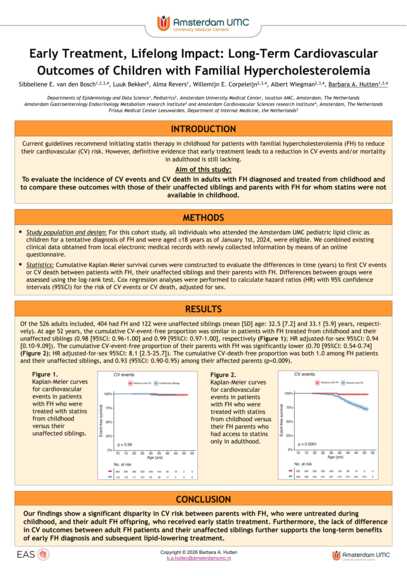
In totaal 526 volwassenen (404 FH-patiënten, gemiddeld 32,5 jaar; 122 niet-aangedane broers/zussen, gemiddeld 33,1 jaar). Op 55-jarige leeftijd was het cumulatieve aandeel zonder cardiovasculair event vergelijkbaar bij vanaf de kindertijd behandelde FH-patiënten en hun niet-aangedane broers/zussen (0,92 vs 0,99; p=1,00), maar significant lager bij hun ouders met FH (0,70; p<0,0001). Het aandeel zonder cardiovasculaire sterfte was 1,0 bij zowel patiënten als broers/zussen, versus 0,93 bij de aangedane ouders (p=0,009).
Conclusie
De bevindingen leveren sterk bewijs voor de langetermijnwinst van vroege FH-diagnose en het vroeg starten met lipidenverlagende behandeling.
Originele Engelstalige samenvatting (zoals ingediend bij EAS 2026)
Background and Aims
Current guidelines recommend initiating statin therapy in patients with familial hypercholesterolemia (FH) at an early age to reduce their future cardiovascular risk. However, definitive evidence that early treatment leads to a reduction in atherosclerotic cardiovascular events and/or mortality in adulthood is still lacking. Therefore, we evaluated the incidence of cardiovascular events and cardiovascular death in adults with FH diagnosed and treated from childhood, and these incidences were compared with those in their unaffected siblings and parents with FH, for whom statins were not available during childhood.
Methods
For this long-term cohort study, all children who attended our specialized pediatric lipid clinic of the Amsterdam University Medical Centers since 1989, were potentially eligible. Children were referred to our center due to a tentative diagnosis of FH based on family history, high cholesterol levels or proven FH in the family. For the present study, we included all children aged ≥18 years on January 1st 2024. Information on cardiovascular health, cardiovascular disease, and the medical histories of both participants and their biological parents were collected through an online survey.
Results
A total of 526 adults (404 FH patients (mean [SD] age 32.5 [7.2] years and 122 unaffected siblings (mean [SD] age 33.1 [5.9] years)) were included. At 55 years of age, the cumulative cardiovascular-event–free proportion was similar in patients with FH treated from childhood and their unaffected siblings (0.92 [95%CI: 0.96-1.00] and 0.99 [95%CI: 0.97-1.00], respectively; p=1.00). The cumulative cardiovascular event-free proportion was significantly lower among their parents with FH (0.70 [95%CI: 0.54-0.74]; p<0.0001; Figure). The cumulative cardiovascular-death–free proportion was both 1.0 among patients with FH and their unaffected siblings, and 0.93 (95%CI: 0.90 – 0.95) among their affected parents (p=0.009).
Conclusions
Our findings provide compelling evidence supporting the long-term benefits of early FH diagnosis and initiation of lipid-lowering treatment.