From registry to reality: FH diagnoses and lipid-lowering therapy use in Dutch children.
- Pediatric And Epidemiology And Data Science, Amsterdam UMC Location University of Amsterdam, Amsterdam, Netherlands
- Department Of Pediatrics And Department Of Epidemiology And Data Science, Amsterdam UMC - Location AMC, Amsterdam, Netherlands
- LEEFH, Amsterdam, Netherlands
- Vascular Medicine, Amsterdam UMC, Amsterdam, Netherlands
- Department Of Pediatrics, Amsterdam UMC, location AMC, Amsterdam, Netherlands
- Department Of Epidemiology And Data Science, Amsterdam UMC, location AMC, Amsterdam, Netherlands
Registratiedata vertaald naar de praktijk: krijgen Nederlandse kinderen met FH daadwerkelijk de diagnose én lipidenverlagende therapie?
Bekijk de volledige poster op EAS 2026Poster on board · EAS 2026, Athene
Samenvatting
Achtergrond
FH is een veelvoorkomende autosomaal dominante aandoening (wereldwijd ongeveer 1 op 300). Vroege opsporing en behandeling met lipidenverlagende therapie (LLT) zijn essentieel om premature atherosclerotische hart- en vaatziekten (ASCVD) te voorkomen. De onderzoekers brachten in kaart hoeveel kinderen met FH in Nederland genetisch zijn geïdentificeerd en hoeveel er momenteel LLT krijgen.
Methoden
Cross-sectionele studie met gegevens uit het LEEFH-register (Landelijk Expertisecentrum Erfelijkheidsonderzoek Familiaire Hart- en vaatziekten) en de Stichting Farmaceutische Kengetallen (SFK). Geanonimiseerde demografische CBS-data dienden om het totale aantal kinderen in Nederland in 2024 te schatten.
Resultaten
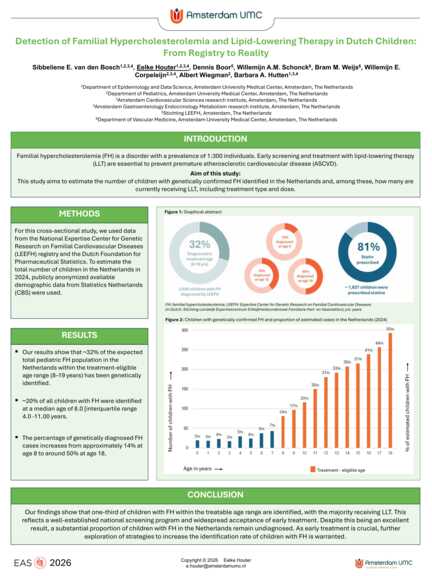
Circa 20% van de verwachte totale pediatrische FH-populatie is door LEEFH genetisch geïdentificeerd (gemiddelde leeftijd 7,6 jaar), waarvan ~32% binnen de behandelbare leeftijd (8–19 jaar). Binnen die groep stijgt het aandeel genetisch gediagnosticeerde FH van ~15% op 8-jarige naar ~50% op 18-jarige leeftijd. In het meest optimistische scenario wordt tot 81% van de kinderen in de behandelbare leeftijd medicamenteus behandeld.
Conclusie
Ondanks de Nederlandse voortrekkersrol in FH-onderzoek en -zorg is een aanzienlijk deel van de kinderen met FH nog niet gediagnosticeerd en daardoor niet tijdig behandeld. Omdat vroege opsporing tijdige LLT binnen het behandelbare leeftijdsvenster mogelijk maakt, moet identificatie van FH op de kinderleeftijd een prioriteit blijven.
Originele Engelstalige samenvatting (zoals ingediend bij EAS 2026)
Background and Aims
Familial hypercholesterolemia (FH) is a common autosomal dominant disorder with a worldwide prevalence of approximately 1 in 300 individuals. Early screening and treatment with lipid-lowering therapy (LLT) are essential to prevent premature atherosclerotic cardiovascular disease (ASCVD). We determined how many children with FH in the Netherlands have been genetically identified and how many children are currently receiving LLT to provide insight into the current state of FH detection and management in children in the Netherlands.
Methods
For this cross-sectional study, we used data from the National Expertise Center for Genetic Research on Familial Cardiovascular Diseases (LEEFH) registry and the Dutch Foundation for Pharmaceutical Statistics (SFK). To estimate the total number of children in the Netherlands in 2024, publicly anonymized available demographic data from Statistics Netherlands (CBS) were used.
Results
Our results show that ~20% of the expected total pediatric FH population in the Netherlands has been genetically identified by LEEFH (mean age 7.6 [standard deviation ±4.78] years), of which ~32% within the treatment-eligible age range (8–19 years). Among the group within the treatable age range, the percentage of genetically diagnosed FH cases increases from approximately 15% at age 8 to around 50% at age 18. In the most optimistic scenario, up to 81% of children in the treatment- eligible age range are being pharmacologically treated.
Conclusions
Our findings show that, despite the Netherlands’ leading role in FH research and care, a substantial proportion of children with FH are not yet diagnosed and therefore not receiving timely treatment. As early detection enables the timely initiation of lipid-lowering therapy during the treatable age window, thereby preventing premature ASCVD, the identification of FH in childhood should remain a key priority.