Increased prevalence of preeclampsia in women with familial hypercholesterolemia
- Internal Medicine, Erasmus Mc Cardiovascular Institute, Erasmus University Medical Center, Rotterdam, Netherlands
- Epidemiology, Erasmus University Medical Center, Rotterdam, Netherlands
- Nutrition, Institute Of Basic Medical Sciences, University of Oslo, Oslo, Norway
- Norwegian National Network For Familial Hypercholesterolemia, Oslo University Hospital, Oslo, Norway
- Obstetrics And Gynecology, Division Of Reproductive Endocrinology And Infertility, Erasmus University Medical Center, Rotterdam, Netherlands
- Cardiology, Erasmus Mc Cardiovascular Institute, Erasmus University Medical Center, Rotterdam, Netherlands
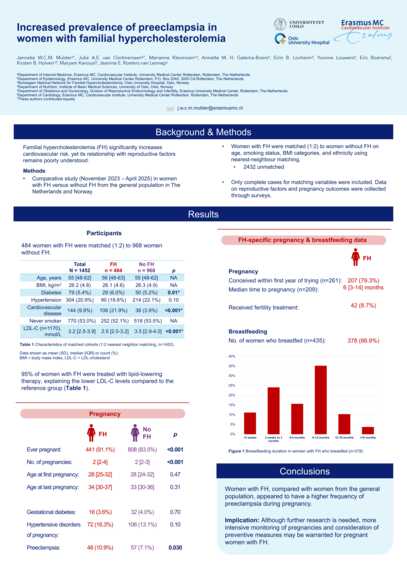
Vrouwen met FH ontwikkelen vaker pre-eclampsie — een sekse-specifiek risicosignaal (Erasmus MC).
Bekijk de volledige poster op EAS 2026Poster on board · EAS 2026, Athene
Samenvatting
Achtergrond
Onderzoek naar zwangerschapsgerelateerde uitkomsten bij vrouwen met FH vergeleken met vrouwen uit de algemene bevolking.
Methoden
Vergelijkende studie (november 2023–april 2025) van vrouwen met en zonder FH. Het FH-cohort bestond uit poliklinische patiënten ≥40 jaar uit universitaire ziekenhuizen in Noorwegen en Nederland. Het referentiecohort kwam voort uit aangeschreven vrouwen plus aanvullende ziekenhuiscontroles (Noorwegen) en de Rotterdam Study (Nederland). De cohorten werden 1:2 gematcht op leeftijd, rookstatus, BMI-categorie en etniciteit. Gegevens over reproductieve factoren en zwangerschapsuitkomsten werden via vragenlijsten verzameld.
Resultaten
484 vrouwen met FH werden gematcht met 968 vrouwen zonder FH (mediane leeftijd 55 jaar; 93% van Noordwest-Europese afkomst). ASCVD kwam vaker voor bij FH (22% vs 4%; p<0,001); 95% gebruikte LLT (lager LDL-C: 2,5 vs 3,5 mmol/L). Meer FH-vrouwen waren ooit zwanger geweest (91% vs 84%). Er was geen verschil in zwangerschapsdiabetes of hypertensieve zwangerschapsaandoeningen, maar pre-eclampsie kwam vaker voor bij FH (11% vs 7%; p=0,026).
Conclusie
Vrouwen met FH lijken vaker pre-eclampsie te ervaren dan vrouwen uit de algemene bevolking, in lijn met recent Noors onderzoek. Hoewel verder onderzoek nodig is, kunnen intensievere zwangerschapsmonitoring en preventieve maatregelen bij vrouwen met FH gerechtvaardigd zijn.
Originele Engelstalige samenvatting (zoals ingediend bij EAS 2026)
Background and Aims
To investigate pregnancy-related outcomes among women with familial hypercholesterolemia (FH) compared with women from the general population.
Methods
We conducted a comparative study of women with FH and women without FH from the general population (November 2023–April 2025). The FH cohort included outpatients aged ≥40 years from two university hospitals in Norway and the Netherlands. The reference cohort was drawn from 2000 women invited by mail plus additional hospital-recruited controls in Norway and the Rotterdam Study in the Netherlands. Cohorts were matched (1:2) on age, smoking status, BMI categories, and ethnicity using nearest-neighbour matching. Only complete cases with regards to matching variables were included. Data on reproductive factors and pregnancy outcomes were collected through surveys.
Results
A total of 484 women with FH were matched with 968 women without FH. Median age was 55 [IQR 48-62] years, and 93% were of North-Western European ethnicity. ASCVD prevalence was higher in women with FH (22% vs 4%, p<0.001). Most women with FH (95%) were treated with lipid-lowering therapy explaining the lower LDL-C levels compared to the reference group (2.5 [IQR 2.0-3.2] vs 3.5 [IQR 2.9-4.0] mmol/L, p<0.001). More women with FH had ever been pregnant (91% vs 84%, p<0.001). No difference was observed in gestational diabetes (4% vs 4%, p=0.89) and hypertensive disorder of pregnancy (16% vs 13%; p=0.14). Preeclampsia was more often experienced by women with FH (11% vs 7%, p=0.026).
Conclusions
Women with FH, compared with women from the general population, appeared to have a higher frequency of preeclampsia during pregnancy. This is consistent with findings of a recent Norwegian study (PMID: 40669098). Although further research is needed, more intensive monitoring of pregnancies and consideration of preventive measures may be warranted for pregnant women with FH.