N=1-studies in statin-intolerance; objectifying nocebo effects (NISONE): a protocol for a randomized controlled trial assessing the implementability of n=1-studies to promote the use of statins
- Internal Medicine, Erasmus University Medical Center, Rotterdam, Netherlands
- Hospital Pharmacy, Erasmus University Medical Center, Rotterdam, Netherlands
- Apotheek A15, Gorinchem, Netherlands
- Internal Medicine, Rijnstate, Arnhem, Netherlands
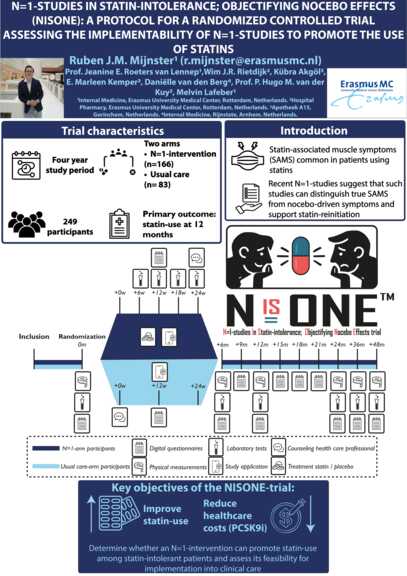
NISONE-protocol: n=1-studies om het nocebo-effect bij statine-intolerantie te objectiveren (Erasmus MC).
Bekijk de volledige poster op EAS 2026Virtuele e-poster · EAS 2026, Athene
Samenvatting
Achtergrond
Lipidenverlagende therapieën, met name statines, zijn cruciaal in de preventie van hart- en vaatziekten. Hun effectiviteit wordt echter vaak ondermijnd door statinegerelateerde spierklachten, met therapieontrouw, staken of overstap naar duurdere middelen (PCSK9-remmers, bempedoïnezuur) tot gevolg. N=1-interventies kunnen mogelijk echte bijwerkingen onderscheiden van nocebo-gedreven klachten en het herstarten van statines ondersteunen.
Methoden
De NISONE-trial includeert 249 patiënten met ASCVD of FH die twee of meer statines staakten wegens vermeende klachten. Randomisatie (2:1) naar een N=1-interventie of gebruikelijke zorg. De interventie bestaat uit vier dubbelblinde periodes van zes weken met statine (rosuvastatine 10 mg of atorvastatine 20 mg, 1–2 tabletten/dag) of placebo; klachten worden via een speciaal ontwikkelde app geregistreerd. In een vijfde periode volgt een persoonlijk feedbackrapport, besproken met een zorgverlener. Primaire uitkomst: percentage patiënten dat na één jaar de statine continueert; ook kosteneffectiviteit wordt beoordeeld.
Resultaten
Tot nu toe zijn 23 deelnemers geïncludeerd (16 in de interventiegroep).
Conclusie
NISONE onderzoekt of een N=1-interventie het statinegebruik bij statine-intolerante patiënten kan bevorderen en of de aanpak haalbaar is voor klinische implementatie — mogelijk een praktische manier om therapietrouw te verhogen, klachten te verminderen en zorgkosten te verlagen.
Originele Engelstalige samenvatting (zoals ingediend bij EAS 2026)
Background and Aims
Lipid-lowering therapies, particularly statins, are crucial in the prevention of cardiovascular disease. Yet their effectiveness is often compromised by statin-associated muscle symptoms, leading to non-adherence, discontinuation and/or switching to alternative, more expensive therapies such as PCSK9-inhibitors or bempedoic acid. Recent studies suggest that N=1- interventions may help distinguish true side effects from nocebo-driven symptoms and support reinitiation of statin-therapy.
Methods
The “N=1-studies In Statin-intolerance; Objectifying Nocebo Effects” (NISONE) trial is a study that will include 249 patients with atherosclerotic cardiovascular disease or familial hypercholesterolemia who stopped using two or more statins due to perceived symptoms. Participants will be randomized (2:1) to an N=1-intervention or usual care. The intervention consists of four double-blind six-week periods of statin- (rosuvastatin 10mg 1-2 tablets/day or atorvastatin 20mg 1-2 tablets/day) or placebo-treatment. Patients are required to record their symptoms through questionnaires in an application developed for this study. During the subsequent fifth treatment period, feedback on symptoms during the intervention periods is provided in a personalized report, which will be discussed with a healthcare professional. Statin continuation is encouraged if symptoms are similar for statin and placebo periods, but remains voluntary. Statin-intolerant patients in the usual care group will be treated according to the cardiovascular risk management guidelines. The primary outcome, the percentage of patients continuing their statin after one year, will be analyzed using odds ratios and 95%-confidence intervals. Secondary outcomes will be analyzed similarly, and cost-effectiveness will be assessed using SURE, adjusted for baseline scores, costs, and quality of life.
Results
Up until now, 23 participants have been included (16/23 intervention-group)
Conclusions
The NISONE trial assesses whether an N=1-intervention can promote statin-use in statin-intolerant patients and evaluates its feasibility for clinical implementation. This trial could provide a practical approach to enhance statin adherence, reduce symptoms, and lower healthcare costs by decreasing prescriptions of more costly lipid-lowering therapies.