Patient preferences for PCSK9 inhibitors: a discrete choice experiment
- Internal Medicine, Erasmus Mc Cardiovascular Institute, Erasmus University Medical Center, Rotterdam, Netherlands
- Erasmus School Of Health Policy And Management, Erasmus University Rotterdam, Rotterdam, Netherlands
- Internal Medicine, Bravis ziekenhuis, Roosendaal, Netherlands
- Internal Medicine, Catharina ziekenhuis, Eindhoven, Netherlands
- Internal Medicine, Gelderse Vallei Hospital, Ede, Netherlands
- Internal Medicine, Rijnstate Hospital, Arnhem, Netherlands
- Internal Medicine, Franciscus Gasthuis & Vlietland, Rotterdam, Netherlands
- Cardiology, Franciscus Gasthuis & Vlietland, Rotterdam, Netherlands
- Internal Medicine, Albert Schweitzer ziekenhuis, Dordrecht, Netherlands
- Cardiology, Treant Zorggroep, Emmen, Netherlands
- Internal Medicine, Maasstad ziekenhuis, Rotterdam, Netherlands
- Cardiology, Amsterdam University Medical Center, Amsterdam, Netherlands
- Cardiology, Diakonessenhuis, Utrecht, Netherlands
- Internal Medicine, Elisabeth TweeSteden hospital, Tilburg, Netherlands
- Vascular Medicine, University Medical Center Utrecht, Utrecht, Netherlands
- Cardiology, Thoraxcentrum Twente, Medisch Spectrum Twente, Enschede, Netherlands
- Cardiology, Zuyderland Medical Center, Heerlen, Netherlands
- Internal Medicine, Zuyderland Medical Center, Heerlen, Netherlands
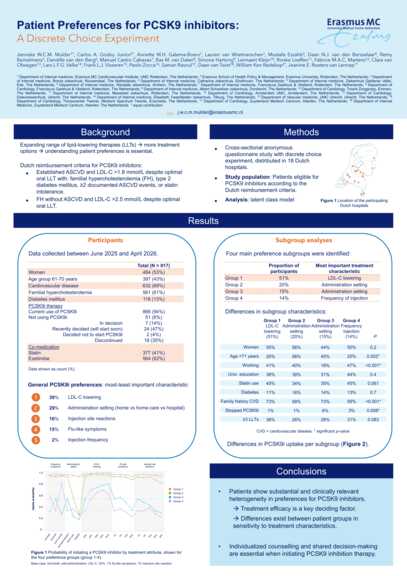
Wat vinden patiënten zélf belangrijk aan PCSK9-remmers? Een discrete-choice-experiment binnen een breed Nederlands netwerk (Erasmus MC).
Bekijk de volledige poster op EAS 2026Poster on board · EAS 2026, Athene
Samenvatting
Achtergrond
Met steeds meer beschikbare lipidenverlagende therapieën nemen de behandelkeuzes toe. Deze studie onderzoekt welke kenmerken van PCSK9-remmers patiënten het belangrijkst vinden, met als secundaire doelen het verkennen van subgroepverschillen, het kwantificeren van afwegingen en het ondersteunen van gedeelde besluitvorming.
Methoden
Cross-sectionele studie met een discrete-choice-experiment (DCE) in een anonieme online vragenlijst verspreid over 15 Nederlandse ziekenhuizen. Deelnemers maakten 12 keuzetaken tussen hypothetische PCSK9-behandelingen die varieerden in cholesterolverlaging, risico op huidreacties, risico op griepachtige klachten, doseerfrequentie en toedieningssetting. Voorlopige analyse over de periode mei–november 2025.
Resultaten
447 patiënten namen deel (50% vrouw, 69% ASCVD, 65% FH); 85% gebruikte een monoklonale antistof en 12% siRNA. Gemiddeld was LDL-verlaging het meest bepalende kenmerk, maar de voorkeuren verschilden sterk. Vier subgroepen werden onderscheiden: twee groepen (samen 46%) hechtten het meest aan de toedieningssetting, één (27%) aan maximale LDL-verlaging en één (27%) aan het vermijden van huidreacties. Hogere leeftijd, lagere opleiding, FH, eerder myocardinfarct en statinegebruik hingen significant samen met specifieke subgroepen.
Conclusie
Patiënten verschillen aanzienlijk en klinisch relevant in hoe zij de kenmerken van PCSK9-behandeling waarderen. Dit onderstreept het belang van geïndividualiseerde counseling en kan bijdragen aan meer patiëntgerichte behandelbeslissingen.
Originele Engelstalige samenvatting (zoals ingediend bij EAS 2026)
Background and Aims
With more lipid-lowering therapies available, treatment choices are increasing. This study aims to identify which PCSK9 inhibitor treatment characteristics patients value most. Secondary objectives were to explore subgroup differences in preferences, quantify patient trade-offs, and generate insights to support shared decision-making in clinical practice.
Methods
In this cross-sectional study, patient preferences for PCSK9 inhibitors were assessed using a discrete choice experiment (DCE) embedded in an anonymous online survey across 15 Dutch hospitals. Participants completed background questions and 12 choice tasks comparing hypothetical PCSK9 inhibitor treatment options varying in cholesterol-lowering effectiveness, risk of skin reactions, risk of flu-like symptoms, dosing frequency, and administration setting. Preliminary analyses were conducted on data collected between May and November 2025.
Results
A total of 447 patients participated (44% with age 61-70 years, 50% women, 69% ASCVD, 65% FH). Most patients were using a PCSK9 inhibitor (85% monoclonal antibody, 12% siRNA), while 1% were considering PCSK9 inhibitor initiation and 2% discontinued PCSK9 inhibition therapy. On average, LDL-cholesterol reduction was the most influential treatment characteristic determining treatment choices. However, preference patterns varied between patients, and preference heterogeneity analysis identified four distinct subgroups: group 1 and group 4 (20% and 26%, respectively) prioritizing administration setting, group 2 (27%) prioritizing maximal LDL-C reduction, and group 3 (27%) prioritizing avoidance of skin-reaction risk. These preference subgroups differed in their sensitivity to changes in treatment characteristic levels. Older age, lower educational level, familial hypercholesterolemia, prior myocardial infarction, and statin use were all significantly associated with membership in specific preference subgroups (figure 1, p<0.05).
Conclusions
Patients show substantial and clinically relevant heterogeneity in how they value different characteristics of PCSK9 inhibitor therapy. These insights highlight the importance of individualized counselling and may inform more patient-centered treatment decisions. Ongoing data collection will allow for more precise subgroup estimates and strengthen the implications for clinical practice.