Personalised dosing of PCSK9-monoclonal antibodies evolocumab and alirocumab: an in silico study
- Department Of Hospital Pharmacy, Erasmus University Medical Center, Rotterdam, Netherlands
- Department Of Internal Medicine, Erasmus University Medical Center Cardiovascular Institute, Erasmus University Medical Center, Rotterdam, Netherlands
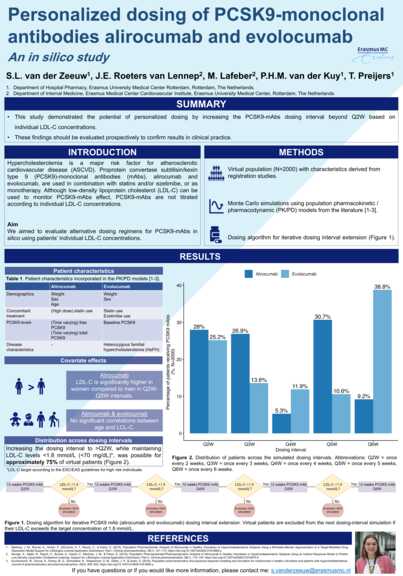
In-silicomodel voor gepersonaliseerde dosering van de PCSK9-antistoffen evolocumab en alirocumab (Erasmus MC).
Bekijk de volledige poster op EAS 2026Virtuele e-poster · EAS 2026, Athene
Samenvatting
Achtergrond
Hypercholesterolemie is een belangrijke risicofactor voor ASCVD. De PCSK9-antistoffen alirocumab en evolocumab worden niet getitreerd op de individuele LDL-waarde, terwijl het LDL-verlagend effect sterk varieert en de kosten hoog zijn vergeleken met statines/ezetimibe. Deze studie evalueerde in silico alternatieve doseerschema's op basis van de individuele LDL-concentratie.
Methoden
In-silicostudie met een virtuele populatie (N=2000) met patiëntkenmerken afgeleid uit registratiestudies. Monte-Carlo-simulaties met gepubliceerde populatie-PK/PD-modellen voor evolocumab en alirocumab (PKPDSim in R). Bij virtuele patiënten met een LDL <1,8 mmol/L op de standaarddosis (eens per 2 weken, Q2W) werd het doseerinterval stapsgewijs verlengd tot Q6W.
Resultaten
Circa 70% van de virtuele patiënten bereikte na 12 weken een LDL onder de streefwaarde en kon het doseerinterval verlengen. Voor evolocumab was verlenging naar Q3W/Q4W/Q5W/Q6W mogelijk bij respectievelijk 17/13/11/28% van de patiënten, en voor alirocumab bij 26/5/31/11%.
Conclusie
De studie toont de mogelijkheid van gepersonaliseerde dosering door verlenging van het PCSK9-doseerinterval op basis van de individuele LDL-waarde. Dit doseerschema moet echter prospectief worden bevestigd in de klinische praktijk.
Originele Engelstalige samenvatting (zoals ingediend bij EAS 2026)
Background and Aims
Hypercholesterolemia is a major risk factor for atherosclerotic cardiovascular disease (ASCVD). Proprotein convertase subtilisin/kexin type 9 (PCSK9)-monoclonal antibodies (mAbs) alirocumab and evolocumab are used in combination with statins and/or ezetimibe or as monotherapy. Although low-density lipoprotein cholesterol (LDL-C) can be used to monitor PCSK9- mAb effect, PCSK9-mAbs are not titrated according to individual LDL-C concentrations. These drugs convey a large variability in LDL-C lowering effect, suggesting opportunities for personalized dosing. Moreover, the costs of PCSK9-mAbs are high in comparison with statins/ezetimibe. Therefore, this study aims to evaluate alternative dosing regimens in silico for PCSK9-mAbs using the patients’ individual LDL-C concentrations.
Methods
This in silico study was performed using a virtual population (N=2000) with patient characteristics derived from registration studies. Monte Carlo simulations were performed using evolocumab and alirocumab population pharmacokinetic/pharmacodynamic (popPK/PD) models from literature[Nicolas et al.,Kuchimanchi et al.]. Simulations were executed using the PKPDSim package in R version 4.3.2[Keizer et al.]. The dosing interval of virtual patients with LDL-C concentrations <1.8 mmol/L, considered as treatment target for patients at high ASCVD risk[Mach et al.], at the standard dose (once every 2 weeks (Q2W)) was extended to Q3W (Fig.1). This extension was iterated until Q6W.
Results
In total, approximately 70% of virtual patients achieved LDL-C values below the treatment target and could extend the dosing interval beyond Q2W after 12 weeks of treatment. Extending the evolocumab dosing interval to Q3W, Q4W, Q5W, and Q6W was possible for 17%, 13%, 11%, and 28% of patients, respectively. Extending the alirocumab dosing interval to Q3W, Q4W, Q5W, and Q6W was possible for 26%, 5%, 31%, and 11% of patients, respectively.
Conclusions
In conclusion, this study demonstrated the possibility of personalized dosing by increasing the PCSK9-mAbs dosing interval beyond Q2W based on individual LDL-C concentrations. However, this dosing regimen should be evaluated prospectively to confirm results in clinical practice.