Pharmacokinetics and safety of obicetrapib in moderate hepatic impairment: phase I study results
- NewAmsterdam Pharma, Naarden, Netherlands
- NewAmsterdam Pharma, Naarden, United States of America
- Nucleus Network, Minneapolis, United States of America
- The Texas Liver Institute, San Antonio, United States of America
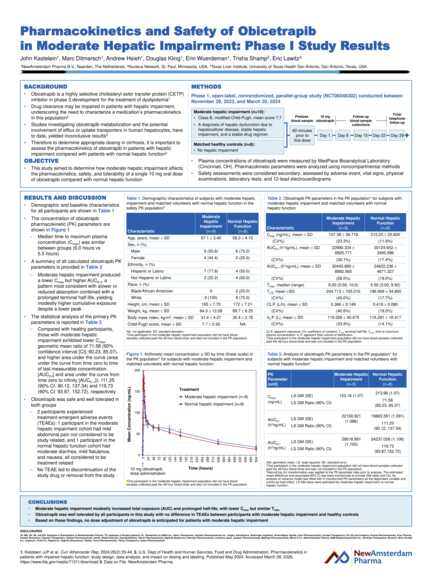
Fase I-onderzoek naar farmacokinetiek en veiligheid van obicetrapib bij matige leverfunctiestoornis (NewAmsterdam Pharma, Naarden).
Bekijk de volledige poster op EAS 2026Poster on board · EAS 2026, Athene
Samenvatting
Achtergrond
Obicetrapib, een zeer selectieve remmer van het cholesterylester-transfereiwit (CETP), bevindt zich in fase III-ontwikkeling voor dyslipidemie. Inzicht in de farmacokinetiek bij leverfunctiestoornis is van belang voor juist gebruik. Deze studie onderzocht hoe matige leverfunctiestoornis de farmacokinetiek, veiligheid en verdraagbaarheid van een eenmalige orale dosis obicetrapib 10 mg beïnvloedt.
Methoden
Fase I, open-label studie met parallelle groepen (NCT06048302) bij deelnemers met matige leverfunctiestoornis (Child-Pugh klasse B; gemiddelde score 7,7; n=10) en gematchte gezonde controles (n=8). Alle deelnemers kregen op dag 1 een eenmalige orale dosis van 10 mg; bloedafnames tot 168 uur, met follow-up tot dag 29. Niet-compartimentele PK-analyse.
Resultaten
Vergeleken met gezonde deelnemers hadden personen met matige leverfunctiestoornis een lagere piekconcentratie (C_max; geometrische ratio 71,6) en een hogere blootstelling (AUC0–∞ ratio 119,7). De mediane tijd tot piek was vergelijkbaar (6,0 vs 5,5 uur). Obicetrapib was in beide groepen veilig en goed verdragen.
Conclusie
Matige leverfunctiestoornis verhoogt de blootstelling aan obicetrapib licht, zonder de tijd tot piekconcentratie te beïnvloeden. Op grond hiervan wordt geen dosisaanpassing verwacht.
Originele Engelstalige samenvatting (zoals ingediend bij EAS 2026)
Background and Aims
Obicetrapib, a highly selective cholesteryl ester transfer protein (CETP) inhibitor, is in phase III development for dyslipidemia. Understanding its pharmacokinetics in hepatic impairment is critical for informed clinical use. To determine appropriate dosing in cirrhosis, it is important to assess pharmacokinetics in hepatic impairment. This study aimed to determine how moderate hepatic impairment affects the pharmacokinetics, safety, and tolerability of a single 10 mg oral dose of obicetrapib compared with normal hepatic function.
Methods
This phase I, open-label, parallel-group study (NCT06048302) enrolled participants with moderate hepatic impairment (Class B, Modified Child-Pugh; mean score 7.7; n=10) and matched healthy controls (n=8). All participants received a single 10 mg oral dose on Day 1. Blood samples were collected through 168 hours post-dose (Day 8), with follow-up on Days 15, 22, and a telephone check on Day 29. Pharmacokinetic parameters were analyzed using non-compartmental methods.
Results
Compared with healthy participants, those with moderate hepatic impairment exhibited lower maximum plasma concentration (C_max): geometric mean ratio 71.58 (90% CI: 60.23, 85.07) and higher area under the curve (AUC_0–last and AUC_0–∞): 111.25 (90% CI: 90.12, 137.34) and 119.73 (90% CI: 93.87, 152.72), respectively. Median time to C_max was similar (6.0 h vs 5.5 h). Obicetrapib was safe and well-tolerated in both groups.
Conclusions
Moderate hepatic impairment modestly increased obicetrapib exposure without affecting time to peak concentration. Based on these findings, no dose adjustment is anticipated.