Prevalence of dyslipidemias in children with a chronic condition: first results from the SMART-YOUTH study.
- Pediatric Cardiology, Wilhelmina Children’s Hospital, University Medical Center Utrecht, Utrecht, Netherlands
- Social Pediatrics, Wilhelmina Children’s Hospital, University Medical Center Utrecht, Utrecht, Netherlands
- Pediatric Pulmonology, Wilhelmina Children’s Hospital, University Medical Center Utrecht, Utrecht, Netherlands
- Pediatric Cardiology, Sophia Children’s Hospital, Erasmus Medical Center, Rotterdam, Netherlands
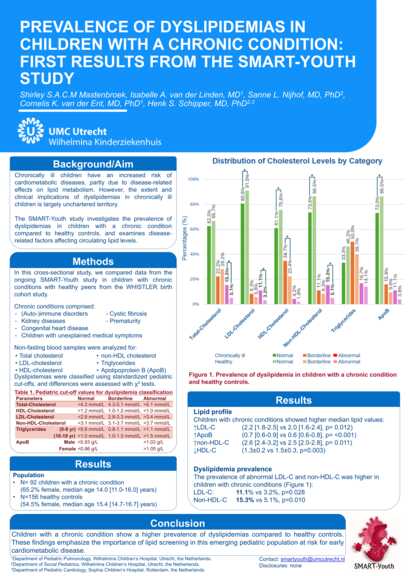
SMART-YOUTH: prevalentie van dyslipidemie bij kinderen met een chronische aandoening (UMC Utrecht).
Bekijk de volledige poster op EAS 2026Virtuele e-poster · EAS 2026, Athene
Samenvatting
Achtergrond
Chronisch zieke kinderen hebben een verhoogd risico op cardiometabole ziekten, deels door ziektegerelateerde effecten op het lipidenmetabolisme. De omvang en klinische betekenis van dyslipidemie bij deze kinderen zijn echter grotendeels onbekend. De SMART-Youth-studie onderzoekt de prevalentie van dyslipidemie bij chronisch zieke kinderen ten opzichte van gezonde controles en de ziektegerelateerde factoren die de lipidenwaarden beïnvloeden.
Methoden
Cross-sectionele vergelijking van de lopende SMART-Youth-studie (kinderen met chronische aandoeningen: (auto-)immuunziekten, cystische fibrose, nierziekten, aangeboren hartafwijkingen, prematuriteit en onverklaarde klachten) met gezonde leeftijdsgenoten uit het WHISTLER-geboortecohort. Niet-nuchtere bloedmonsters werden onderzocht op totaal-, LDL-, HDL- en non-HDL-cholesterol, triglyceriden en apoB; dyslipidemie werd geclassificeerd met gestandaardiseerde pediatrische afkapwaarden.
Resultaten
56 kinderen met een chronische aandoening (mediaan 14 jaar) versus 156 gezonde controles. De chronisch zieke kinderen hadden hogere mediane waarden voor LDL-C (2,2 vs 2,0), non-HDL-C (2,7 vs 2,5) en apoB (0,7 vs 0,6) en een lager HDL-C (1,3 vs 1,5). Afwijkend LDL-C (11,4% vs 3,2%) en non-HDL-C (15,9% vs 5,1%) kwamen vaker voor.
Conclusie
Chronisch zieke kinderen hebben vaker dyslipidemie dan gezonde controles. Dit benadrukt het belang van lipidenscreening in deze opkomende pediatrische risicogroep voor vroege cardiometabole ziekte.
Originele Engelstalige samenvatting (zoals ingediend bij EAS 2026)
Background and Aims
Chronically ill children have an increased risk of cardiometabolic diseases, partly due to disease-related effects on lipid metabolism. However, the extent and clinical implications of dyslipidemias in chronically ill children is largely unchartered territory. The Secondary Manifestations of ARTerial disease in the Young with a chronic condition (SMART-Youth) study investigates the prevalence of dyslipidemias in children with a chronic condition compared to healthy controls, and examines disease-related factors affecting circulating lipid levels.
Methods
In this cross-sectional study, we compared data from the ongoing SMART-Youth study in children with chronic conditions with healthy peers from the WHISTLER birth cohort study. Chronic conditions comprised (auto-)immune disorders, cystic fibrosis, kidney diseases, congenital heart disease, prematurity, and children with unexplained medical symptoms. Non-fasting blood samples were analyzed for total cholesterol, LDL-cholesterol, HDL-cholesterol, non-HDL cholesterol, triglycerides, and apolipoprotein B (ApoB). Dyslipidemias were classified using standardized pediatric cut-offs, and differences were assessed with χ² tests.
Results
With ongoing inclusions, 56 children with a chronic condition are currently enrolled in the SMART-Youth study (68.5% female, median age 14.0 [11.0-15.0] years), compared to 156 healthy controls (54.5% female, median age 15.4 [14.7-16.7] years). Children with chronic conditions showed higher median lipid values, including LDL-C (2.2 [1.8-2.6] vs 2.0 [1.6-2.4], p= 0.034), non-HDL-C (2.7 [2.4-3.2] vs 2.5 [2.0-2.8], p= 0.012), and ApoB (0.7 [0.6-0.9] vs 0.6 [0.6-0.8], p= 0.003), while mean HDL-C was lower (1.3±0.2 vs 1.5±0.3, p=0.002). Regarding dyslipidemia phenotypes, the prevalence of abnormal LDL-C and non-HDL-C was higher in children with chronic conditions (LDL-C: 11.4% vs 3.2%, p=0.044; Non-HDL-C: 15.9% vs 5.1%, p=0.025).
Conclusions
Children with a chronic conditions show a higher prevalence of dyslipidemias compared to healthy controls. These findings emphasize the importance of lipid screening in this emerging pediatric population at risk for early cardiometabolic disease.