Rationale and design of 25-year follow-up of patients with familial hypercholesterolemia treated with statins since childhood: the AFTER25-study
- Pediatric And Epidemiology And Data Science, Amsterdam UMC Location University of Amsterdam, Amsterdam, Netherlands
- Department Of Pediatrics And Department Of Epidemiology And Data Science, Amsterdam UMC - Location AMC, Amsterdam, Netherlands
- Department Of Pediatrics, Amsterdam UMC, location AMC, Amsterdam, Netherlands
- Department Of Epidemiology And Data Science, Amsterdam UMC, location AMC, Amsterdam, Netherlands
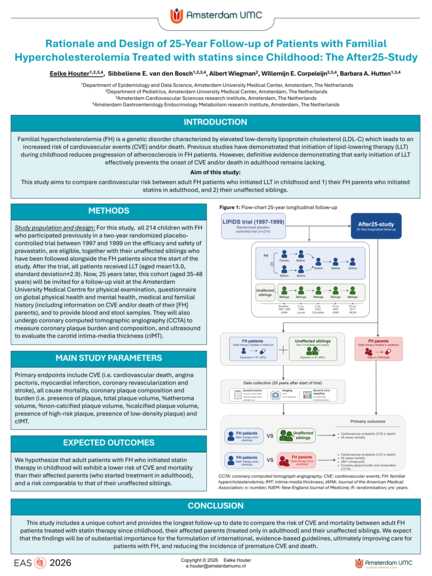
Opzet van de AFTER25-studie: 25 jaar follow-up van patiënten die sinds hun kindertijd statines krijgen voor FH.
Bekijk de volledige poster op EAS 2026Poster on board · EAS 2026, Athene
Samenvatting
Achtergrond
FH wordt gekenmerkt door een vanaf de geboorte verhoogd LDL-cholesterol en een verhoogd risico op cardiovasculaire events (CVE) en sterfte. Eerdere studies toonden dat starten met LLT in de kindertijd de progressie van atherosclerose remt, maar definitief bewijs dat vroeg starten ook CVE en sterfte op volwassen leeftijd voorkomt ontbreekt. AFTER25 vergelijkt het cardiovasculaire risico van volwassen FH-patiënten die als kind met statines startten met (1) hun FH-ouders die pas op volwassen leeftijd startten en (2) hun niet-aangedane broers/zussen.
Methoden
Alle 214 kinderen met FH die in 1997–1999 deelnamen aan een tweejarige placebogecontroleerde trial met pravastatine komen, samen met hun niet-aangedane broers/zussen, in aanmerking. Nu, 25 jaar later, wordt dit cohort (35–48 jaar) uitgenodigd in het Amsterdam UMC voor lichamelijk onderzoek, vragenlijsten, medische en familiaire voorgeschiedenis en bloed- en ontlastingsmonsters, plus CCTA en echografie.
Resultaten
Primaire eindpunten zijn CVE (cardiovasculaire sterfte, angina pectoris, myocardinfarct, coronaire revascularisatie en beroerte), mortaliteit, coronaire plaque-belasting (o.a. aanwezigheid en volume van plaque, %atheoomvolume, %niet-verkalkt en %verkalkt plaquevolume, hoogrisicoplaque) en intima-media-dikte van de carotis.
Conclusie
Dit wordt de eerste follow-upstudie van deze omvang die het risico op CVE en sterfte vergelijkt tussen vanaf de kindertijd met statines behandelde FH-patiënten, hun (pas op volwassen leeftijd behandelde) aangedane ouders en hun niet-aangedane broers/zussen.
Originele Engelstalige samenvatting (zoals ingediend bij EAS 2026)
Background and Aims
Familial hypercholesterolemia (FH) is a genetic disorder characterized by elevated low-density lipoprotein cholesterol (LDL-C) from birth and subsequently increased risk of cardiovascular events (CVE) and/or death. Previous studies have demonstrated that initiation of lipid- lowering therapy (LLT) during childhood reduce progression of atherosclerosis in FH patients. However, definitive evidence demonstrating that early initiation of LLT effectively prevents the onset of CVE and/or death in adulthood remains lacking. This study aims to compare cardiovascular risk between adult FH patients who initiated statin therapy in childhood and 1) their FH parents who initiated statins in adulthood, and 2) their unaffected siblings.
Methods
All 214 children with FH who participated previously in a two-year randomized placebo- controlled trial between 1997 and 1999 on the efficacy and safety of pravastatin, are eligible for the current study, together with their unaffected siblings. After the trial, all patients received LLT. Now, 25 years later, this cohort (aged 35-48 years) will be invited for a follow-up visit at the Amsterdam University Medical Centre (AUMC) for physical examination, completion of questionnaires on global physical health and mental health, medical and familial history (including information on CVE and/or death of their [FH] parents), and to provide blood and stool samples. They will also undergo CCTA and ultrasound.
Results
Primary endpoints include CVE (i.e. cardiovascular death, angina pectoris, myocardial infarction, coronary revascularization and stroke), mortality, coronary plaque burden (i.e. presence of plaque, total plaque volume, %atheroma volume, %non-calcified plaque volume, %calcified plaque volume, presence of high-risk plaque, presence of low-density plaque) and carotid intima-media thickness.
Conclusions
This will be the first follow-up study to this extent to compare the risk for CVE and mortality in adult FH patients treated with statin therapy since childhood, their affected parents (treated only in adulthood) and their unaffected siblings.