Voices of those recruiting: barriers and enablers to women's participation in cardiovascular trials. a qualitative study
- Department Of Internal Medicine, Cardiovascular Institute, Erasmus MC, University Medical Center, Rotterdam, Netherlands
- Department Of Cardiology, Amsterdam Heart Centre, Amsterdam Cardiovascular Sciences, VU University Medical Center, Amsterdam, Netherlands
- Laboratory For Experimental Cardiology, Department Of Cardiology, University Medical Center Utrecht, Utrecht University, Utrecht, Netherlands
- WCN (Dutch Network for Cardiovascular Research), Utrecht, Netherlands
- Department Of Cardiology, Red Cross Hospital, Beverwijk, Netherlands
- Department Of Cardiology, Cardiovascular Institute, Erasmus MC, University Medical Center, Rotterdam, Netherlands
- Department Of Medical Psychology And Psychotherapy, Erasmus MC, University Medical Center, Rotterdam, Netherlands
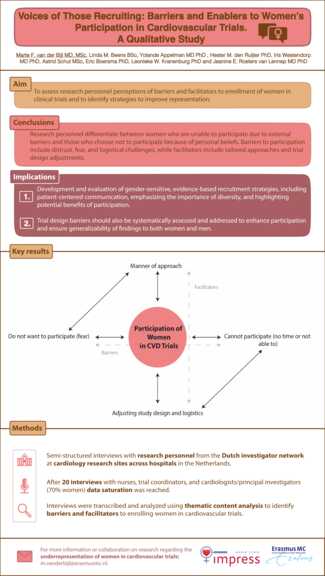
Kwalitatieve studie naar barrières en kansen voor deelname van vrouwen aan cardiovasculair onderzoek (Erasmus MC).
Bekijk de volledige poster op EAS 2026Poster on board · EAS 2026, Athene
Samenvatting
Achtergrond
Vrouwen blijven ondervertegenwoordigd in cardiovasculaire klinische trials, ook gecorrigeerd voor ziekteprevalentie. Onderzoekspersoneel dat verantwoordelijk is voor de werving van patiënten kan uniek inzicht geven in de redenen achter deze ondervertegenwoordiging.
Methoden
Kwalitatieve interviewstudie (2024) met een vooraf opgestelde topicgids. Semigestructureerde interviews met verpleegkundigen, trialcoördinatoren en cardiologen/hoofdonderzoekers (70% vrouw) uit het Nederlandse cardiovasculaire onderzoeksnetwerk (WCN), geworven uit vijf Nederlandse ziekenhuizen. De transcripties werden geanalyseerd met thematische inhoudsanalyse.
Resultaten
Na twintig interviews werd dataverzadiging bereikt. De analyse leverde drie hoofdthema's op: het belang van diversiteit, barrières en bevorderende factoren. Belangrijkste barrières voor deelname van vrouwen: 1) wantrouwen jegens onderzoek, 2) angst voor bijwerkingen, 3) niet voldoen aan de inclusiecriteria en 4) zorgtaken of tijdgebrek. Bevorderende factoren vielen uiteen in een aangepaste, persoonlijke benadering en aanpassingen in de studieopzet (vaste man-vrouwverhouding, vrouw-only trials, logistiek).
Conclusie
De geïnterviewden onderscheiden vrouwen die níet kunnen deelnemen door externe barrières van vrouwen die afzien op grond van persoonlijke overtuigingen. Toekomstig onderzoek zou moeten nagaan hoe het vrouwelijke perspectief kan worden verwerkt in (sekse-specifieke) wervingsstrategieën, patiënteninformatie en studieopzet om de deelname van vrouwen te vergroten.
Originele Engelstalige samenvatting (zoals ingediend bij EAS 2026)
Background and Aims
Women remain underrepresented in cardiovascular clinical trials, even when accounting for disease prevalence. Research personnel responsible for patient recruitment may provide unique insights into the reasons behind low representation of women.
Methods
In 2024, we conducted a qualitative interview study using a predefined topic guide. Semi- structured interviews were conducted with nurses, trial coordinators, and cardiologists/principal investigators (70% women) participating in the Dutch cardiovascular investigators network (WCN). Interviewees were recruited from five hospitals across the Netherlands. Interviews were transcribed and analyzed using thematic content analysis to identify barriers and facilitators to enrolling women in cardiovascular trials.
Results
After twenty interviews, data saturation was reached. Analysis of the transcripts resulted in a hierarchical framework with three main themes: importance of diversity in trials, barriers to participation, and facilitators for participation. The importance of diversity in trials was widely recognized and considered a challenge. The main barriers for women to participate in trials mentioned by research personnel were: 1) distrust in research, 2) fear of side effects of medication, 3) not meeting inclusion criteria, and 4) caregiving responsibilities or lack of time to participate. Facilitators for participation were divided into two categories: 1) manner of approach, focusing on customized recruitment strategies, and 2) adjusting study design, including a fixed ratio of women in trials, women-only trials, and logistics of the trial.
Conclusions
Interviewees distinguish between women who are unable to participate due to external barriers and those who decline participation because of personal beliefs. Barriers to participation include distrust, fear, and logistical challenges, while facilitators include tailored approaches and trial design adjustments. Future research should examine how the female perspective in trial participation can be incorporated into general and sex-specific recruitment strategies, patient information, and trial design, as implementing such approaches may enhance female participation in future cardiovascular clinical trials.