Impact of evinacumab on coronary plaques in patients with homozygous familial hypercholesterolemia: protocol of the "EVOLVE-HoFH" study
- Vascular Medicine, Amsterdam UMC, Amsterdam, Netherlands
- S.I.S.A foundation, Milan, Italy
- Sorbonne Universite, INSERM UMR1166, Lipidology and Cardiovascular Prevention Unit, Department of Nutrition, APHP, Hopital Pitie-Salpetriere, Paris, France
- Ege University Medical Faculty, Turkey, Turkey
- Faculty of Medicine, the John Paul II Catholic University of Lublin, Lublin, Poland
- Ciccarone Center for the Prevention of Cardiovascular Disease, Johns Hopkins University School of Medicine, Baltimore, MD, United States of America
- Liverpool Centre for Cardiovascular Science (LCCS), Liverpool, United Kingdom
- Medicine, Division Of Translational Medicine And Human Genetics, Perelman School Of Medicine, University of Pennsylvania, Philadelphia, United States of America
- Ultragenyx Pharmaceutical, Inc., Novato, California, United States of America
- IRCCS MultiMedica, Sesto S. Giovanni, Milan, Italy
- University of Milan, Milan, Italy
- Amsterdam UMC, Amsterdam, Netherlands
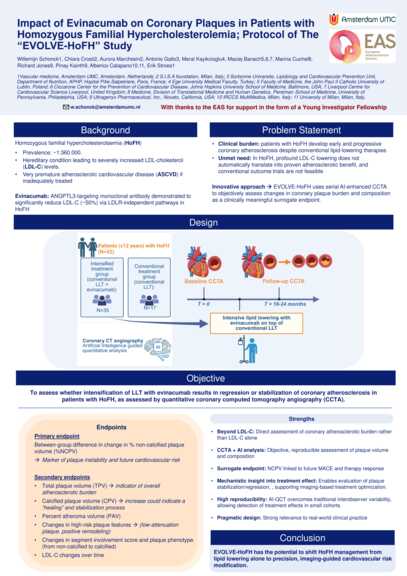
Protocol van de EVOLVE-HoFH-studie naar het effect van evinacumab op coronaire plaque bij homozygote FH (met Stroes, Amsterdam UMC).
Bekijk de volledige poster op EAS 2026Poster on board · EAS 2026, Athene
Samenvatting
Achtergrond
Homozygote FH (HoFH) is een zeldzame, ernstige aandoening met een extreem verhoogd LDL-cholesterol vanaf de geboorte en versnelde, premature ASCVD. Evinacumab, een antistof tegen ANGPTL3, verlaagt het LDL-C in deze groep sterk, maar het directe effect op de coronaire plaque-belasting is nog onbekend. Door de zeldzaamheid zijn gerandomiseerde placebogecontroleerde MACE-trials onhaalbaar. EVOLVE-HoFH onderzoekt of intensivering van LLT met evinacumab leidt tot regressie of stabilisatie van coronaire atherosclerose, beoordeeld met kwantitatieve CT-coronairangiografie (CCTA).
Methoden
EVOLVE-HoFH is een real-world, observationele, internationale multicenterstudie (prospectief en retrospectief). Met CCTA — een gevalideerde surrogaatmarker — wordt de verandering in plaquevolume vergeleken tussen patiënten die met evinacumab starten (“geïntensiveerde groep”) en een conventioneel behandelde vergelijkingsgroep. Primair eindpunt is het verschil in verandering van het percentage niet-verkalkt plaquevolume (%NCPV), een belangrijke indicator van plaque-instabiliteit, tussen baseline en 18–24 maanden follow-up.
Resultaten
Niet van toepassing — dit betreft de publicatie van het studieprotocol; dataverzameling en analyse lopen nog.
Conclusie
Deze pragmatische opzet is bedoeld om de obstakels van onderzoek bij zeldzame ziekten te omzeilen en levert naar verwachting het eerste bewijs voor een gunstig effect van evinacumab op coronaire atherosclerose.
Originele Engelstalige samenvatting (zoals ingediend bij EAS 2026)
Background and Aims
Homozygous Familial Hypercholesterolemia (HoFH) is a rare and severe genetic disorder characterized by extremely elevated low-density lipoprotein cholesterol (LDL-C) levels from birth onwards, leading to accelerated and premature atherosclerotic cardiovascular disease (ASCVD). Evinacumab, a monoclonal antibody targeting angiopoietin-like protein 3 (ANGPTL3), has been shown to effectively reduce LDL-C in this population. However, its direct impact on coronary atherosclerotic plaque burden remains to be established. Given the rarity of the condition, randomized placebo-controlled clinical trials on major adverse cardiovascular events (MACE) are unfeasible. The EVOLVE-HoFH study aims to determine whether intensification of lipid- lowering therapy (LLT) with evinacumab results in regression or stabilization of coronary atherosclerosis in patients with HoFH, as assessed by quantitative coronary computed tomography angiography (CCTA).
Methods
EVOLVE-HoFH is a real-world, observational, multicenter, international study (prospective and retrospective) designed to assess whether intensification of lipid-lowering therapy (LLT) with Evinacumab leads to regression or stabilization of the coronary atherosclerotic plaque burden as well as altered composition in patients with HoFH. The study will use Coronary Computed Tomography Angiography (CCTA), a validated surrogate risk marker, to compare changes in plaque volume in a group of patients initiating treatment with Evinacumab ("intensified treatment group") with a "conventional treatment comparator group." The primary endpoint is the difference in change in percent non-calcified plaque volume (%NCPV), a key indicator of plaque instability, between baseline and 18-24 months follow-up.
Results
Not applicable – study protocol publication. Data collection and analysis are ongoing.
Conclusions
This pragmatic methodological approach is designed to overcome the barriers of research in rare diseases, allowing for the evaluation of a clinically relevant and mechanistically informative surrogate efficacy endpoint. The results will provide the first evidence of the beneficial impact of Evinacumab on coronary atherosclerosis, filling an important knowledge gap.